








By using this site, you agree to the Privacy Policy and Terms of Use.
Accept
EduTodayEduToday
  • Home
  • Education
    Education
    Show More
    Top News
    Update about Victoria’s International Student Arrivals Plan
    November 1, 2021
    Supporting Students with Disabilities in Vocational Education and Training
    March 24, 2022
    Foster a culture of continuous learning
    July 17, 2022
    Latest News
    What kind of leader should you become?
    October 24, 2022
    What it takes to become a successful strategic learner
    October 24, 2022
    Instructional strategies: what are they?
    October 24, 2022
    Pandemic-related drop in enrolments and delays in student visa approvals causing chaos for RTOs
    August 12, 2022
  • VET Sector
    VET Sector
    Show More
    Top News
    Some ESOS courses are no longer required to be registered with CRICOS
    August 8, 2021
    Message from the CEO (1 Nov 2021)
    November 1, 2021
    Summary of Contextualising teaching and learning – A guide for VET teachers
    July 17, 2022
    Latest News
    What are the plans for improving the vocational education and training sector – what are we missing?
    October 24, 2022
    A message from the CEO (October 2022)
    October 24, 2022
    Message from the CEO (12 August 2022)
    August 12, 2022
    In vocational education and training, what is assessment?
    August 12, 2022
  • HEP Sector
    HEP Sector
    Show More
    Top News
    Online learning is much more than access to training and assessment materials online
    August 22, 2021
    University jobs lost at a rate of ‘one in five’ as COVID-19 border laws continue to bite
    September 19, 2021
    Interview with Peter Doukas – Managing Director, Denison Toyer Education Lawyers
    November 1, 2021
    Latest News
    Contract cheating – One out of every ten students submits assignments written by someone else – and the vast majority of them get away with it.
    January 31, 2022
    Interview with Peter Doukas – Managing Director, Denison Toyer Education Lawyers
    November 1, 2021
    University jobs lost at a rate of ‘one in five’ as COVID-19 border laws continue to bite
    September 19, 2021
    Online learning is much more than access to training and assessment materials online
    August 22, 2021
  • School Sector
    School Sector
    Show More
    Top News
    Part 1- The importance of internal audits
    September 8, 2021
    Transition planning and requirements
    March 24, 2022
    Management of operational risks in training organisations
    October 24, 2022
    Latest News
    Management of operational risks in training organisations
    October 24, 2022
    Strategies on how to promote your training organisation to international students
    October 24, 2022
    Creating a work environment that values employees
    October 24, 2022
    Continually reviewing, improving and self-assurance
    October 24, 2022
  • Australia
    Australia
    Show More
    Top News
    Part 3- How compliance and quality assurance are two separate but intertwined concepts
    July 21, 2021
    The implications of ASQA being moving to a full cost recovery agency
    October 1, 2019
    Interview – Andrew Shea – CEO, Builders Academy Australia
    October 14, 2021
    Latest News
    During the IHEA Dual-Sector Network conference, Sukh Sandhu addressed issues and changes in the VET sector.
    August 12, 2022
    ASQA’s as a national training package assurance body
    July 17, 2022
    A database of cheating websites has been updated through intelligence sharing.
    July 17, 2022
    An ASQA initiative called Pathways and Perspectives has been launched
    July 17, 2022
  • Science & Tech
    Science & Tech
    Show More
    Top News
    Various phases of the assessment and validation processes (Part 2)
    August 13, 2021
    Assessment issues that may have an impact on your RTO audit (Part 1)
    August 5, 2021
    Assessment issues that may have an impact on your RTO audit (Part 2)
    August 18, 2021
    Latest News
    The purpose of due-diligence audits
    August 12, 2022
    Set boundaries, establish guidelines, and work within them.
    June 27, 2022
    Message from the CEO
    October 14, 2021
    Why organisations should prioritise systematic continuous improvement as a strategic priority
    October 14, 2021
  • More
    • TV
    • Movies
Reading: The drop in traineeships and apprenticeships. Why is it happening?
Notification Show More
Latest News
Australian gov’t to review HE in long-term plan
News
Australia declined 50% of student visa applications from India in 2022
News
New Victoria University program gives high school leavers ‘space’ to figure out future
News
Fee-free TAFE and VET places for South Australians – Ai Group comment
News
CQU vocational education leader receives accolade
News
Aa
Aa
EduTodayEduToday
  • Business
  • Industry
  • Politics
  • Home
    • Home 1
    • Home 2
    • Home 3
    • Home 4
    • Home 5
  • Categories
    • Industry
    • Business
    • Politics
  • Bookmarks
  • More Foxiz
    • Sitemap
Have an existing account? Sign In
Follow US
  • Advertise
© 2022 Foxiz News Network. Ruby Design Company. All Rights Reserved.
NewsTAFE

The drop in traineeships and apprenticeships. Why is it happening?

Vijay
Last updated: 2019/12/03 at 1:54 AM
By Vijay 5 Min Read

A recent figures revealed that the federal government over the last five years has underspent close to $1 billion of its budget on TAFE, training and apprenticeships. This is on top of previous cuts.

At the same time, that these budgets cuts are happening, Australia is still experiencing critical skills shortages in several industries.  A number of experts have warned of serious effects on the Australian economy.

The report released by the Australian Industry Group can be found here: www.aigroup.com.au

It also identified: 

  • Skills shortages: 75 percent of respondents reported skills shortages in industry, a jump from 49 percent in the previous survey conducted in 2016. Shortages are most often in the technician and trades worker category, with difficulties recruiting for Science, technology, engineering, and mathematics (STEM) skills, and new shortages for roles in business automation, Big Data and artificial intelligence solutions.
  • Literacy and Numeracy: 99 percent of employers (up from 96 per cent in 2016) are affected in some way by low levels of literacy and numeracy in their workforce. This is disturbing in a time when the workforce increasingly requires foundation skills that include not only literacy and numeracy but digital literacy and advanced soft skills.
  • Leadership and Management: employers are prioritising technology capability improvements for managers, 62 percent of whom believe a lack of leadership and management skills is having a high impact on the business (up from 56 percent in 2016). This reflects the major changes needed in the way work is done and managed as entire business processes and organisational cultures are upended in the digital economy.

At the time of its 2018 survey, Ai Group called for new approaches to education, training and re-skilling to maximise the benefits of the digital economy.

“Our survey has found major skills demand issues facing employers,” chief executive Innes Willox said.

“It provides an important gauge of employer sentiment around skill needs, education and training at a critical time for industry transformation.”

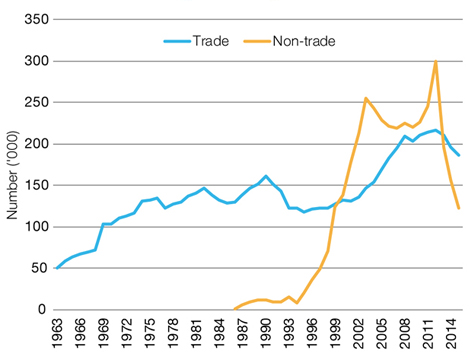
Image Source: NCVER, Apprentices and trainees 2015 December quarter


The number of Australians completing an apprenticeship or traineeship is lower today than it was a decade ago.

Let’s look at the apprentices and trainees data now over the last few years. 

Since 2013, according to data compiled by the National Centre for Vocational Education Research (NCVER), apprentice numbers have dropped by 25 to 50 percent.

The number of apprentices and trainees who commenced training in September 2013 dropped by 49.56 per cent from 71,600 to 36,115 by September 2017.

The number of apprentices and trainees who were in training during this same period dropped by 34.7 percent from 413,300 to 269,905.

Apprentice and trainee completion rates from September 2013 also dropped from 35,900 by 35.86 per cent to 23,025 by September 2017.

The figures from NCVER to the end of December 2018 show the number of apprentices and trainees who commenced training dropped from 71,600 in September 2013 to 33,760 in December 2018, representing a 52.85 per cent fall.

The number of apprentices and trainees in-training dropped from 413,300 in September 2013 to 259,385 in December 2018, resulting in a 37.24 per cent reduction during the time period.

The number of apprentices and trainees who completed their training in September 2013 dropped from 35,900 to 26,780 in December 2018.

What are the reasons for this fall in numbers? Some of the factors are: 

  • Government policies reducing the subsidised training courses offerings
  • Focusing on public education and training organisations and neglecting the private education providers
  • Too many expectations from employers and not enough rewards,
  • No effective education and training reforms No or less engagement of group training organisations
  • Too much bureaucracy and paperwork
  • Ineffective In-School VET programs
  • Few Multi-Industry Pre-Apprenticeship programs
  • A regulator that does not understand the changing needs of the time and learners or
  • A mix of all these factors? 

We believe the more investment in the public and private training and education organisations and policy and regulatory changes are the only ways to move forward.

 

Post Views: 119

[ruby_related total=5 layout=5]

Previous Article Where are we going and why are we here?
Next Article Has the Australian Skills Quality Authority taken Australia back 30 years?
EduTodayEduToday

© 2022 EduToday. Online Media Solutions. All Rights Reserved.

Removed from reading list

Undo
Welcome Back!

Sign in to your account

Lost your password?