









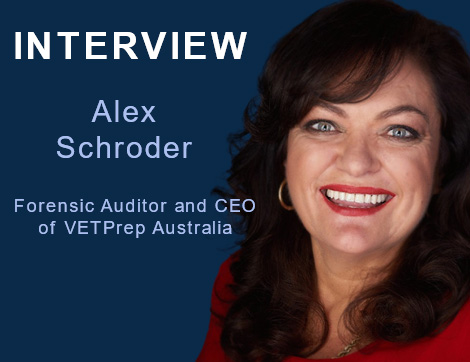
Alex is Australia’s leading VET Compliance Specialist, Forensic Auditor, and the CEO of VETPrep Australia. With qualifications Law, Commerce, Marketing, Management, Business, Quality Assurance and Strategic Leadership, Alex’s expertise is unsurpassed. She is the creator of the Certificate IV in RTO Compliance, Diploma of RTO Compliance Management, The RTO Standards Unpacked! and other courses. Alex is a member of ASQA’s inaugural Stakeholder Liaison Group and the ITECA Queensland State Committee, and is actively involved in the future of the VET sector.
Sukh Sandhu spoke to Alex Schroder in this interview:
Q1: You operate a registered training organisation that specialises in compliance and auditing training; can you tell us a little bit more about your organisation and the courses you offer?
I don’t operate an RTO; I am the CEO of VETPrep Australia, which is a specialist Compliance Rectification consultancy. VETPrep does however work hand-in-hand with the Australian Institute of Compliance Professionals (AICP). AICP offers the Certificate IV in RTO Compliance and the Diploma of RTO Compliance Management, which I developed in 2018. It also offers non-accredited courses like the RTO Standards Unpacked! and the Foundations of RTO Compliance courses. AICP is the only RTO in Australia that specialises in offering accredited training to the VET sector and its scope includes the Diploma of Quality Auditing, Compliance Skill Set, Lead Auditor Skill Set and also offers the Graduate Diploma of Management (Learning) and Graduate Diploma of Strategic Leadership via RPL. The Certificate IV in RTO Compliance and Diploma of RTO Compliance Management courses are the first of its kind and have proven to be hugely popular with VET Compliance Practitioners. The RTO Standards Unpacked! and the Foundations of RTO Compliance courses are fairly new and the enrolment numbers in these courses have been unprecedented.
VETPrep provides specialist compliance rectification and sanction management services to domestic and CRICOS providers, assistance with initial registration of RTOs, compliance maintenance and management services, bespoke professional development training, and organisational change and growth advice.
As a trained lawyer, I have been recognised by the Administrative Appeals Tribunal (AAT) as an industry expert and VETPrep has an unsurpassed reputation for achieving successful sanction appeals outcomes.
Q2: You are one of the very few recognised quality industry experts and leaders that we have in Australia, so how has your experience been working with ASQA to assist them in the transition process that they are currently undergoing?
As a member of the ASQA Stakeholder Liaison Group, I also sit on subcommittees focused on self-assurance, audit practices, online learning in the VET sector, and VET delivered to secondary school students. The ASQA that we are working with these days is a far cry from the ASQA of pre-2020 ASQA. Under the former Commissioner, ASQA operated under a cloud of fear and prosecution, instead of focusing on regulating the VET sector. I’m sure we all remember 2018 when ASQA tried to cancel more than 300 RTOs for not submitting their Annual Declaration on Compliance! ASQA’s current focus however is one of collaboration with the VET sector and providing guidance and education on how to comply with the NVR Act and the RTO Standards.
From a regulatory operations view, ASQA has also changed its approach to conducting regulatory audits and its regulatory monitoring practices. Regulatory audit practices have become more just and equitable than they were in the past and RTOs are provided with sufficient notice of the full scope of an ASQA audit, evidence to be submitted and overall, the audit experience that they can anticipate.
Since the implementation of ASQA’s reformed regulatory practices, the VETPrep team and I have helped dozens of RTOs successfully apply to ASQA for internal reviews of regulatory decisions. Two years ago these RTOs would have not had the opportunity of successful internal reviews and would have had no option but to spend tens of thousands of dollars in saving their RTO registration through Administrative Appeals Tribunal (AAT) appeals and/or trials.
While ASQA still has a lot of work to do on its regulatory reform, but when I consider the enormous raft of changes that have already been implemented, I have no doubt that our sector will flourish in a regulatory regime that is finally designed to regulate RTOs in a fair, just and economically sustainable manner.
Q3: What are the top five legitimate reasons for a regulatory body to impose severe sanctions on a training provider?
The majority of RTOs operate ethically and honestly and go to exceptional lengths to provide quality training to learners. This being said, unfortunately, there are still a small number of RTOs that are prepared to sacrifice quality for the sake of increased profits. During a recent forensic audit, we identified an RTO in Queensland that was selling TAE qualifications for $2,500; all that was required was an enrollment form and the upfront payment for these certificates. Other RTOs actively encourage their trainers and assessors to mark assessments using the “tick and flick” methodology, thereby facilitating findings of competence where learners have not adequately evidenced competency in the requirements of a training product, while some providers still show a blatant disregard for the quality and duration of their course delivery. It is not uncommon to hear some providers justify the inadequate delivery of training programs as something they need to do in order to remain competitive and profitable.
Although the instances of “cowboy RTO” activities have reduced significantly over the last few years, unfortunately, these practices are not as uncommon as we would like to think and RTOs that participate in these types of practices do so with little, if any, consideration for the disrepute brought to the VET sector.
A regulatory body should impose severe sanctions on a training provider in the following instances:
- Issuing fraudulent AQF certification documentation
- Systemically disregarding the requirements of the RTO Standards, the NVR Act and other legislative requirements
- Fraudulent claims for government funding, where training and assessment have not been delivered
- Systemic, deliberate and active attempts to mislead regulators
Q5: When should representatives of RTOs seek the advice of a legal expert, and what types of services do you provide to those who seek your guidance?
There are at least four instances where RTOs must seek expert VET compliance and/or legal advice:
- Applying for the initial registration of an RTO is a long, complicated and costly process and requires expertise. VETPrep is often asked to help potential RTO owners appeal unsuccessful initial registration applications, and although we have a stellar reputation in providing successful outcomes, the time, cost and potential loss of income to the new RTO could have been minimised by engaging expert assistance in the beginning. But, potential RTO owners are not solely to blame, unfortunately there are a large number of VET Compliance Practitioners who promote themselves as experts, yet do not have the required knowledge and expertise to produce the required outcomes.
- RTOs should contact a Rectification Specialist when they have failed an audit and are facing possible sanctions as a result. We often see providers who have failed audits, attempt to rectify and/or remediate non-compliance without engaging external expertise, believing that they have the internal capabilities to successfully do so. This mindset never fails to baffle me; after all, if an RTO did have the internal expertise required, they would surely not have failed the audit in the first place.
- Where the Regulator is considering the cancellation of an RTO’s registration, both compliance expertise and legal representation is paramount, as the cost of saving the business and the business owners’ livelihood, often pale in comparison to the cost of saving the RTO’s registration.
- Potential RTO purchasers must always insist on a Forensic Audit of the RTO being considered for purchase; this is part of the purchaser’s due diligence and is as essential as financial and legal due diligence. There is a misconception that a change of RTO ownership is an opportunity for “new beginnings” vis-a-vis the RTO’s compliance history but nothing can be further from the truth; an RTO’s compliance history and risk rating is vested in the owners of the RTO, regardless of the management structure at the time of any non-compliances occurring. This means that an RTOs compliance history stays with it indefinitely and without conducting a pre-acquisition audit, an RTO purchaser cannot fully know what it is that they are buying.