








By using this site, you agree to the Privacy Policy and Terms of Use.
Accept
EduTodayEduToday
  • Home
  • Education
    Education
    Show More
    Top News
    The authenticity of assessments in an online learning environment
    October 14, 2021
    What characteristics define a successful online learner?
    March 24, 2022
    Education, training, and audits are essential to ensure compliance.
    June 12, 2022
    Latest News
    What kind of leader should you become?
    October 24, 2022
    What it takes to become a successful strategic learner
    October 24, 2022
    Instructional strategies: what are they?
    October 24, 2022
    Pandemic-related drop in enrolments and delays in student visa approvals causing chaos for RTOs
    August 12, 2022
  • VET Sector
    VET Sector
    Show More
    Top News
    I want to voice my opinion – Your letters and emails to us
    December 17, 2019
    Strategies to maintain VET and Industry currency as a trainer and assessor
    October 14, 2021
    How to become a trainer and assessor in Australia.
    May 22, 2022
    Latest News
    What are the plans for improving the vocational education and training sector – what are we missing?
    October 24, 2022
    A message from the CEO (October 2022)
    October 24, 2022
    Message from the CEO (12 August 2022)
    August 12, 2022
    In vocational education and training, what is assessment?
    August 12, 2022
  • HEP Sector
    HEP Sector
    Show More
    Top News
    Online learning is much more than access to training and assessment materials online
    August 22, 2021
    University jobs lost at a rate of ‘one in five’ as COVID-19 border laws continue to bite
    September 19, 2021
    Interview with Peter Doukas – Managing Director, Denison Toyer Education Lawyers
    November 1, 2021
    Latest News
    Contract cheating – One out of every ten students submits assignments written by someone else – and the vast majority of them get away with it.
    January 31, 2022
    Interview with Peter Doukas – Managing Director, Denison Toyer Education Lawyers
    November 1, 2021
    University jobs lost at a rate of ‘one in five’ as COVID-19 border laws continue to bite
    September 19, 2021
    Online learning is much more than access to training and assessment materials online
    August 22, 2021
  • School Sector
    School Sector
    Show More
    Top News
    Part 2- How compliance and quality assurance are two separate but intertwined concepts
    July 7, 2021
    CAQA FAQ Series – Industry consultation
    November 1, 2021
    During the IHEA Dual-Sector Network conference, Sukh Sandhu addressed issues and changes in the VET sector.
    August 12, 2022
    Latest News
    Management of operational risks in training organisations
    October 24, 2022
    Strategies on how to promote your training organisation to international students
    October 24, 2022
    Creating a work environment that values employees
    October 24, 2022
    Continually reviewing, improving and self-assurance
    October 24, 2022
  • Australia
    Australia
    Show More
    Top News
    The rapid review of ASQA announced by Senator the Hon Michaelia Cash, Minister for Employment, Skills, Small and Family Business
    December 17, 2019
    The disadvantages of ASQA not following ISO auditing management systems
    June 12, 2022
    Coronavirus travel ban sees Chinese students miss start of university, Australia’s tertiary…
    February 18, 2020
    Latest News
    During the IHEA Dual-Sector Network conference, Sukh Sandhu addressed issues and changes in the VET sector.
    August 12, 2022
    ASQA’s as a national training package assurance body
    July 17, 2022
    A database of cheating websites has been updated through intelligence sharing.
    July 17, 2022
    An ASQA initiative called Pathways and Perspectives has been launched
    July 17, 2022
  • Science & Tech
    Science & Tech
    Show More
    Top News
    Unpacking ASQA audit reports and files (Part 1)
    September 18, 2019
    Various phases of the assessment and validation processes (Part 3)
    August 31, 2021
    Unpacking ASQA audit reports and files (Part 3)
    October 1, 2019
    Latest News
    The purpose of due-diligence audits
    August 12, 2022
    Set boundaries, establish guidelines, and work within them.
    June 27, 2022
    Message from the CEO
    October 14, 2021
    Why organisations should prioritise systematic continuous improvement as a strategic priority
    October 14, 2021
  • More
    • TV
    • Movies
Reading: Continuous problem-solving processes for a training organisation
Notification Show More
Latest News
Australian gov’t to review HE in long-term plan
News
Australia declined 50% of student visa applications from India in 2022
News
New Victoria University program gives high school leavers ‘space’ to figure out future
News
Fee-free TAFE and VET places for South Australians – Ai Group comment
News
CQU vocational education leader receives accolade
News
Aa
Aa
EduTodayEduToday
  • Business
  • Industry
  • Politics
  • Home
    • Home 1
    • Home 2
    • Home 3
    • Home 4
    • Home 5
  • Categories
    • Industry
    • Business
    • Politics
  • Bookmarks
  • More Foxiz
    • Sitemap
Have an existing account? Sign In
Follow US
  • Advertise
© 2022 Foxiz News Network. Ruby Design Company. All Rights Reserved.
News

Continuous problem-solving processes for a training organisation

Vijay
Last updated: 2022/11/24 at 3:51 PM
By Vijay 5 Min Read

One of the most important things for any training organisation is to have a good problem-solving process in place. This allows internal stakeholders to learn from their mistakes and improve their skills.

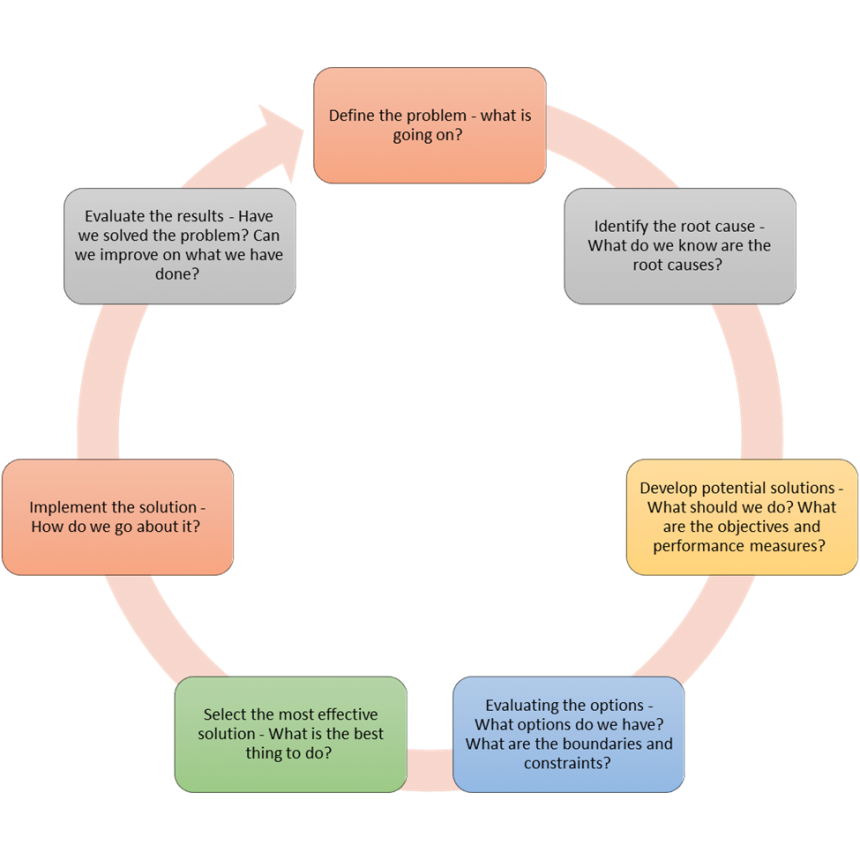
The seven most effective steps for continuous problem-solving for a training organisation include: 

  1. Define the problem – what is going on?
  2. Identify the root cause – What do we know are the root causes?
  3. Develop potential solutions – What should we do? What are the objectives and performance measures?
  4. Evaluating the options – What options do we have? What are the boundaries and constraints?
  5. Select the most effective solution – What is the best thing to do?
  6. Implement the solution – How do we go about it?
  7. Evaluate the results – Have we solved the problem? Can we improve on what we have done?

Taking each of these steps one at a time, let’s go over them in detail now:

  1. Define the problem: The first step in solving a problem is to identify and define the issue at hand. This can be done by brainstorming with a team or individual and looking at the problem from different angles. Once the problem is defined, it is important to set goals and objectives for solving it.
  2. Identify the root cause: The second step is to identify the root cause of the problem. This can be done by conducting research, collecting data, and analyzing information. Once the root cause is identified, it is important to develop a plan of action for addressing it.
  3. Develop potential solutions: The third step is to develop potential solutions to the problem. This can be done by brainstorming with a team or individual and considering different options such as conducting research. It is important to consider all potential solutions, no matter how far-fetched they may seem at first.
  4. Evaluating the options: Once all of the potential solutions have been generated, it is important to evaluate each one. This can be done by considering the cost, feasibility and effectiveness of each option.
  5. Select the most effective solution: After you identify a problem, it’s important to select the most effective solution. The most effective solution is usually the one that best solves the problem while causing the least amount of negative consequences. To select the most effective solution, you’ll need to consider all of your options and evaluate them against your criteria. Once you’ve selected a solution, you’ll need to implement it implement the solution and then monitor its effectiveness.
  6. Implement the solution: After the problem has been identified and a plan for solving it has been put in place, it is time to implement the solution. This step can involve putting the plan into action, testing the solution to see if it works, and making any necessary adjustments. Once the solution has been implemented, it is important to monitor the situation to make sure that the problem has been solved and that no new problems have arisen. This may require some ongoing tweaking of the solution, but eventually, with patience and perseverance, the problem should be resolved.
  7. Evaluate the results and outcomes: It is important to take the time to evaluate the results of implementing a solution. This will help to determine if the solution was effective and if any changes need to be made. It is also important to document the results so that future problem-solving efforts can be improved.


As an organisation, you must ensure that: 

  1. everyone in the organisation is aware of the process. This includes both staff and students.
  2. encourage everyone to share their problems with others. This can help them get feedback and ideas on how to solve the problem.
  3. have a system in place for tracking problems and solutions. This will help ensure that problems are solved effectively and efficiently.
  4. celebrate successes! recognise students and staff who have solved problems effectively. This will encourage others to do the same.

Post Views: 145

[ruby_related total=5 layout=5]

Previous Article Students allegedly assisted in entering the country to work in the sex industry by Australian colleges
Next Article Choosing quality over quantity as a trainer
Leave a comment

Leave a Reply Cancel reply

Your email address will not be published. Required fields are marked *

EduTodayEduToday

© 2022 EduToday. Online Media Solutions. All Rights Reserved.

Removed from reading list

Undo
Welcome Back!

Sign in to your account

Lost your password?