









By using this site, you agree to the Privacy Policy and Terms of Use.
Accept
EduTodayEduToday
  • Home
  • Education
    Education
    Show More
    Top News
    The role of online education is evolving due to Artificial Intelligence (AI).
    October 14, 2021
    In February 2022, international student arrivals in Australia reached a ‘super-strong’ level.
    March 24, 2022
    Different assessment strategies and training organisations
    July 17, 2022
    Latest News
    What kind of leader should you become?
    October 24, 2022
    What it takes to become a successful strategic learner
    October 24, 2022
    Instructional strategies: what are they?
    October 24, 2022
    Pandemic-related drop in enrolments and delays in student visa approvals causing chaos for RTOs
    August 12, 2022
  • VET Sector
    VET Sector
    Show More
    Top News
    Part 2- How compliance and quality assurance are two separate but intertwined concepts
    July 7, 2021
    Interview with David Jepsen, Founder and Principal of RTO Accountants
    November 1, 2021
    Engaging and retaining students in the vocational education and training sector
    June 12, 2022
    Latest News
    What are the plans for improving the vocational education and training sector – what are we missing?
    October 24, 2022
    A message from the CEO (October 2022)
    October 24, 2022
    Message from the CEO (12 August 2022)
    August 12, 2022
    In vocational education and training, what is assessment?
    August 12, 2022
  • HEP Sector
    HEP Sector
    Show More
    Top News
    Online learning is much more than access to training and assessment materials online
    August 22, 2021
    University jobs lost at a rate of ‘one in five’ as COVID-19 border laws continue to bite
    September 19, 2021
    Interview with Peter Doukas – Managing Director, Denison Toyer Education Lawyers
    November 1, 2021
    Latest News
    Contract cheating – One out of every ten students submits assignments written by someone else – and the vast majority of them get away with it.
    January 31, 2022
    Interview with Peter Doukas – Managing Director, Denison Toyer Education Lawyers
    November 1, 2021
    University jobs lost at a rate of ‘one in five’ as COVID-19 border laws continue to bite
    September 19, 2021
    Online learning is much more than access to training and assessment materials online
    August 22, 2021
  • School Sector
    School Sector
    Show More
    Top News
    Various phases of the assessment and validation processes (Part 2)
    August 13, 2021
    Edu Learning – Your door to professional development opportunities
    January 31, 2022
    The purpose of due-diligence audits
    August 12, 2022
    Latest News
    Management of operational risks in training organisations
    October 24, 2022
    Strategies on how to promote your training organisation to international students
    October 24, 2022
    Creating a work environment that values employees
    October 24, 2022
    Continually reviewing, improving and self-assurance
    October 24, 2022
  • Australia
    Australia
    Show More
    Top News
    I want to voice my opinion – Your letters and emails to us
    December 17, 2019
    An ASQA initiative called Pathways and Perspectives has been launched
    July 17, 2022
    VET ministers announce changes to the Australian Skills Quality Authority
    October 1, 2019
    Latest News
    During the IHEA Dual-Sector Network conference, Sukh Sandhu addressed issues and changes in the VET sector.
    August 12, 2022
    ASQA’s as a national training package assurance body
    July 17, 2022
    A database of cheating websites has been updated through intelligence sharing.
    July 17, 2022
    An ASQA initiative called Pathways and Perspectives has been launched
    July 17, 2022
  • Science & Tech
    Science & Tech
    Show More
    Top News
    How to complete a compliant Trainer Matrix – Part 1 of Part 5
    December 1, 2020
    Message from the CEO
    October 14, 2021
    Writing your Training and Assessment Strategy – Part 1 of Part 5
    December 1, 2020
    Latest News
    The purpose of due-diligence audits
    August 12, 2022
    Set boundaries, establish guidelines, and work within them.
    June 27, 2022
    Message from the CEO
    October 14, 2021
    Why organisations should prioritise systematic continuous improvement as a strategic priority
    October 14, 2021
  • More
    • TV
    • Movies
Reading: Different assessment strategies and training organisations
Notification Show More
Latest News
Australian gov’t to review HE in long-term plan
News
Australia declined 50% of student visa applications from India in 2022
News
New Victoria University program gives high school leavers ‘space’ to figure out future
News
Fee-free TAFE and VET places for South Australians – Ai Group comment
News
CQU vocational education leader receives accolade
News
Aa
Aa
EduTodayEduToday
  • Business
  • Industry
  • Politics
  • Home
    • Home 1
    • Home 2
    • Home 3
    • Home 4
    • Home 5
  • Categories
    • Industry
    • Business
    • Politics
  • Bookmarks
  • More Foxiz
    • Sitemap
Have an existing account? Sign In
Follow US
  • Advertise
© 2022 Foxiz News Network. Ruby Design Company. All Rights Reserved.
Education

Different assessment strategies and training organisations

Vijay
Last updated: 2022/07/17 at 2:55 PM
By Vijay 5 Min Read

There are many different assessment strategies that training organisations can use to evaluate their students’ progress. Some of the most common types of assessment include formative assessment, summative assessment, continuous assessment, norm-directed assessment, criterion-directed assessment and subjective assessment. Each type of assessment has its own advantages and disadvantages, so it is important to choose the right strategy for your organisation’s needs.
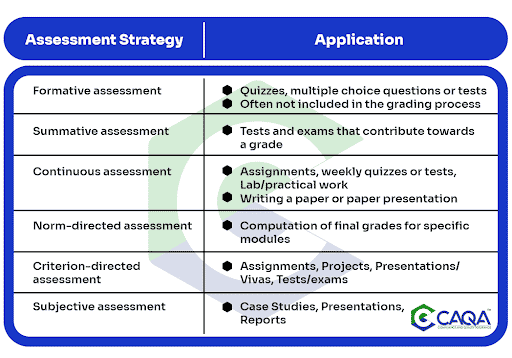
Formative assessment is a great way to provide feedback to students on their progress. It can be used to identify areas where students need improvement and to help them focus on those areas. Formative assessment is a great way to assess learning progress on an ongoing basis. It can help identify areas where students need more support and allows instructors to adjust their teaching methods accordingly. However, formative assessment can be time-consuming, and may not always produce reliable results.

Summative assessment, on the other hand, is more focused on determining whether or not a student has mastered a particular skill or concept. Summative assessment is typically used to evaluate learning at the end of a course or program. It can be used to assess overall performance or to identify areas where students need improvement. Summative assessment is generally more reliable than formative assessment, but it can be more expensive and time-consuming to administer.

Continuous assessment is a process whereby students are assessed regularly throughout the course of their studies, rather than just at the end. This allows for a more accurate picture of student progress. Continuous assessment is a hybrid approach that combines elements of both formative and summative assessment. It allows for ongoing evaluation of learning progress, while still providing a comprehensive overview at the end of a course or program. Continuous assessment can be an effective way to assess student learning, but it requires careful planning and execution to be successful.

Norm-directed assessment is used to compare students against each other, in order to identify areas of strengths and weaknesses. Norm-directed assessment is a type of assessment that compares students against predetermined standards. This approach can be used to evaluate overall performance or to identify areas where students need improvement. Norm-directed assessment is generally reliable, but it can be expensive and time-consuming to administer.

The criterion-directed assessment focuses on specific criteria that must be met in order for a student to be considered proficient. Criterion-directed assessment is a type of assessment that compares students against each other, rather than against predetermined standards. This approach can be used to evaluate overall performance or to identify areas where students need improvement. Criterion-directed assessment is generally reliable, but it can be expensive and time-consuming to administer.

Subjective assessment relies on the opinions of those carrying out the assessment, rather than on objective measures. Subjective assessment is a type of assessment that relies on the opinions of instructors or other experts. This approach can be used to evaluate overall performance or to identify areas where students need improvement. Subjective assessment is generally less reliable than other approaches, but it can be less expensive and time-consuming to administer.

Each type of assessment has its own benefits and drawbacks, so it is important to choose the right strategy for your organisation’s needs. Formative assessment can be time-consuming and may not always give a clear indication of student progress. Summative assessment can be more reliable, but may not provide detailed feedback. Continuous assessment is a good compromise between the two but may be difficult to implement in some organisations. Norm-directed and criterion-directed assessments can be useful for identifying areas of weakness but may be biased if not carried out properly. Subjective assessment is prone to errors but can give a more complete picture of a student’s ability.

Whichever type of assessment you choose, it is important to make sure that it is aligned with the learning objectives of the course, as well as the organisation’s own goals and values. By doing so, you can ensure that your students are getting the most out of their learning experience and that they are able to meet your organisation’s standards.


Post Views: 186

[ruby_related total=5 layout=5]

Previous Article Training and assessment in vocational education and training by unqualified trainers and assessors
Next Article Summary of Contextualising teaching and learning – A guide for VET teachers
EduTodayEduToday

© 2022 EduToday. Online Media Solutions. All Rights Reserved.

Removed from reading list

Undo
Welcome Back!

Sign in to your account

Lost your password?