









BIO:
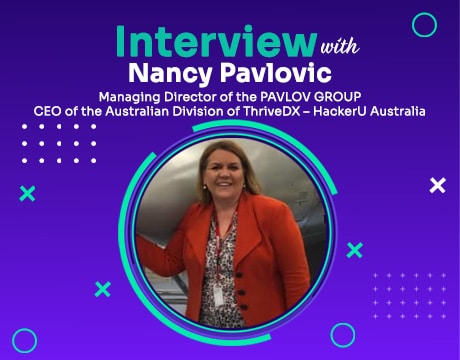
Nancy Pavlovic
Managing Director of the PAVLOV GROUP
CEO of the Australian Division of ThriveDX – HackerU Australia
Nancy Pavlovic is the Managing Director of the PAVLOV GROUP, Behavioural Conditioning of Your Business. She has begun her career in the classroom and has worked in multiple industries including but not limited to Aviation, Automotive, Construction, Information Technology, Defence, and Federal and State Govt. She is an education strategist who is working across the L&D, VET, and HE sectors.
Undertaking her Masters in eLearning is also a Board Member of the Asia Pacific Institute of Learning & Performance. Nancy continues to make waves with her trademark engaging yet straightforward approach to developing lateral solutions where her clients feel a sense of ownership of the changes implemented because she makes the complicated and complex simple.
Nancy has also been recently appointed the Australian Division CEO of ThriveDX-Hacker U Australia a global cyber security education solution provider. She is active on LinkedIn and invites you to follow her path to disrupting cybersecurity education globally because cyber security is everyone’s responsibility.
The following is the interview that Sukh Sandhu, our CEO, conducted with Nancy Pavlovic.
- What inspires you about working in vocational education and training?
VET is both the third pillar of education and the third largest economic driver in Australia’s economy and plays a pivotal role in the workforces of today, and those we need for tomorrow.
It enables people to have a choice in where they build knowledge and skill, where they can consolidate their current steps in career management, and what their next step will be. It allows them to confirm what they can and can’t do, and in equal measure opens doors and improves opportunities through career changes and transitions.
Once a teacher, always a learner, forever an educator. I’m inspired to continue working in VET as it allows me to fuse my passion with my purpose for helping others learn, grow, succeed, and use the education they’ve gained as a key to unlocking their potential and taking ownership of their future, and that my contribution makes a genuine difference in someone’s life.
- What do you think sets VET Professionals apart from other professional disciplines?
What sets us apart hmmm you mean besides change management fatigue? ????
Our passion and commitment to being part of someone’s success. Specifically, the national VET workforce is about 75,000 strong and counting, and what sets us apart from other Professionals in other industry sectors, is that we are required to be vigilant in our awareness and adaptability to changes and maintain a high standard of knowledge and skill in a very regulated industry that undergoes more changes and pivots than the Stelvio Pass in Italy has bends and twists. It can be equal parts challenging and exhausting.
Secondly, the depth of knowledge across a diverse range of industries can be applied at very much a practical real-life basis, careers are transformed, and applied in real-time. We provide solutions quickly to meet industry needs.
Specifically, every year 4.2 million working-age Australians participate in a VET course. That means that collectively, we as practitioners need to have a diverse range of skills and need to be continually updating our currency to remain responsive to industry needs.
The old chestnut needs to be mentioned, we do not have a Registration Board and CPD points are not reflected in the registration or certification of VET practitioners. Yet based on Christopher Ward’s research on VET Practitioner PD hours, an early practitioner with 0-4 years of experience spends on average 39 hours a year undertaking PD, a mid-career with 4-9 years’ experience, hours spends about 149 hours maintaining currency, and a late-career professional spends about 105 hours of PD to stay at the forefront.
- What are the key skills and knowledge required for a successful career in governance, risk management, and compliance?
Firstly, I think we need to be clear on the distinctions between governance, risk management, and compliance before exploring the knowledge and skills needed for a successful career in the management, of each even though they may align and can be integrated based on the maturity of the systems of an organisation.
Because the VET sector is a heavily regulated one, there are many frameworks that are integrated and impact training product and service, the registration, and the operational performance of a training organisation.
Governance provides structure and essentially reflects the relationships between systems and processes and requires people to effectively monitor the risks that impact the products and services based on external factors that affect an organisation’s ability to operate sustainably.
Effective risk management assists an organisation to make decisions to protect the organisations reputation, position, and sustainability when facing volatility, which protects the business.
Compliance builds resilience and helps with the scalability of products and services, prevents defects, and focuses on integrity issues in the same way operations do.
If implemented correctly, the fear of an audit from a regulator disappears.
To work in each of these areas here are my top 5 skills and attributes:
-
- Excellent organisational and time management skills
- Strong and effective problem-solving skills
- Effective Critical Thinking Skills & Interpretation of complex concepts and being able to break them down into a workable process
- Established and refined written and verbal communication skills and people rapport-building skills
- Working understanding of legislation, standards, regulatory guidelines, and frameworks.
I’ve found the REACH© Profiles and the REACH System to be an amazing tool for identifying the key skills of team members. It provides strategies to deal with each profile and what knowledge and skill they need to develop further. If you’d like to know, more go to SuccessBox Solutions they are an award-winning organisation that specialises in REACH Profiling.
- Describe your experience working with clients in the RTO field?
To give this question a fair response perhaps I should be clear that working in the VET sector is only a portion of what I do.
Specifically, I work as a project and change manager of systems, processes, people, performance, profit, capability, and strategy, with a foundation of integrated risk and knowledge management across 11 industries. There is a bit more to it than just the VET sector, and there is a dependency on International as well as Australian Standards, certifications, and accreditations.
My favourite type of project in VET is accredited course development and my two recent examples are an alternative to TAE, for those who work in non-accredited learning the 10893NAT – Certificate IV in Learning Design and Facilitation and the 11062NAT Certificate IV in Offensive Cyber Security. If anyone is interested in knowing more, start with TGA.
What I’ve found over the last 2 decades (yikes I’m old!), of working with RTOs is that they don’t always anticipate or respond to change well, that they don’t always invest in educating and training their staff, many staff are poorly paid, and that detection of problems, often occurs at audit time, and their reactions are based on fear, and
it’s the truly courageous RTOs who want to leave a legacy that understand and have strong values displayed by the right attitude that put the customer at the forefront of every business decision they make that withstand the turbulence of transition and transformation.
- In your opinion what are the biggest challenges faced by RTO practitioners?
Well, how long is a piece of string? There are many challenges practitioners who work in the VET sector and specifically RTOs face. To name just a few, I’d begin with the basics,
The musical chairs of different stakeholders essentially means that we need to be vigilant in paying attention to a plethora of different publications, reforms, reports, training packages changes, training developers, and impacts on training products, the customer journey (the most important shareholder in the process) and being able to keep up to date with the changes without any product integrity or reputational impact.
Understanding the needs of the customer and tailoring your product and service to the industry customer to maximise their employment prospects. This includes understanding your competitors.
Accepting that change is constant, and not being complacent, adapting to the ever-changing work environment, because what worked yesterday may not work tomorrow. Hybrid and remote workforces are here to stay.
Adjusting to online delivery during Covid, and now having customers who have had no choice, now want to choose between face-to-face and online learning. RTOs need to have both options tailored to their customer.
Maintaining currency in an ever-increasing workload, and the need to acknowledge mental health and well-being and the digital age of learning.
It is vital that we invest in our mental health, I highly recommend if you are not following Sally Healey on LinkedIn then go spend a few minutes at the Career Development Centre. To find out more
- In your opinion what are the biggest opportunities for RTO professionals?
RTO professionals need to know more than their clients in terms of being able to turn an issue into an opportunity. They need to be a valuable partner in the business. For example, I turned a cost activity into a revenue stream for one client, through careful evaluation of their activities.
Look at ways to add value to the growth of the business. This can only be achieved (I’ve found) by asking open-ended questions to understand the challenges RTOs face.
The obvious examples are;
-
- How to attract more students? or
- Once you have a student how do you ensure you retain that student? and
- How can you maximise referrals from existing customers? or
- How can you reduce their operating costs? and
- What can you do to prevent staff attrition?
- What do the current changes (given there are so many and so frequently) mean for the business?
The solutions are not always simple. They sometimes can be, but if you can identify the cause and help that business implement strategies to remove the problems then you become an asset, not just another water cooler conversationalist.
- What is the most important piece of advice you’d give to RTO practitioners starting out in their careers?
Tip #1: Understand the difference in responsibilities between being an employee and a contractor. Refer Contractor Act.
Tip #2: If you work under an ABN, you need to have Professional Indemnity. If you don’t have it, go get it. If you don’t know where to start refer to the Asia Pacific Institute of Learning and Performance which is a peak body in the learning and development space. They’ve tailored a special member-only Insurance for RTOs and professionals who work in the VET sector.
Tip #3: If you’re going to provide services to RTOs, step 1 is to provide them with your qualifications, step 2, is a copy of your Certificate of Insurance Currency, and step 3 references from actual clients.
Tip #4: The most important is to invest in yourself, get a mentor, keep learning, stay abreast of all the changes with subscriptions, attend networking events, webinars, and conferences, and read this newsletter!
- What are your thoughts on the current regulatory environment, legislative standards and guidelines, and Government initiatives?
As we move to a more global approach to managing workforce needs, the current regulatory framework must adapt to the needs of the workforce, and therefore be more agile in its reforms, transparency, and its oversight of the integrity of the VET sector must be clear, precise, and easily understood. Basically, it needs to ‘Pass the Pub Test’ in terms of expectation and accountability from our decision makers in Canberra.
It’s going to be a bit of a bumpy ride before we have the clarity, and accountability for our legislation, standards, and regulators. Especially considering the standards that have been revised, and the draft has been released, as well as the changes to the Cert IV in Training and Assessment. It’s a case of Back to the Future, but in preparing for tomorrow, ‘Marty where we’re going, we don’t need roads’.
For training to continue to educate 4 million plus people annually, we need to have an education 4.0 ecosystem that is harmonious with the needs of the economy, and our position globally in time for the competitiveness required in the 4th industrial revolution.
As for government initiatives, the focus must be on digital literacy, preparing our educators and practitioners for engaging learning, and a greater focus on cyber security integrated into every aspect of our day-to-day practices. Tomorrow’s workforce will be digital natives, which means the VET workforce needs to be agile and adapt accordingly.
- What do you think will be the most significant developments in VET over the next 2-5 years?
Aside from the obvious discussions about self-regulation, there are distinct rumblings that ASQA and TEQSA will merge. Time will tell if TEQSA will positively influence the regulation of VET, it’s ‘little engine that could’ cousin.
Employers want staff who are work ready now. My current position is that we will see a greater focus on Micro-credentials, Skill sets, and a greater focus on the use of RPL. Because people change careers and transition into other industries, they come with transferrable skills, and they want them to be recognised.
We’ll be taking a more active interest in catering to neurodiverse learners, and self-regulated learning, we will embed Web Content Access Guidelines (WCAG) into all online, and eLearning designs and hybrid delivery, and assessment.
The end of Contract Cheating, and Assessment factories, (or at least I hope so), with plagiarism tools being part of most LMS systems and becoming a more commonplace practice in RTOs. I remain optimistic that authenticity and integrity checks on learners and staff become standard practice and not the exception.
In addition, more integrated use of VR, AI chatbots, and gamification and less reliance on paper-based learning. Learners want autonomy to choose, so synchronous and asynchronous learning is a must offering, not a nice to have.